

Kitesurfing on Lake Garda
Kitespot Lake Garda
Find all the answers here.
Lake Garda — Perfect Kitesurfing Conditions for Beginners to Advanced Riders
Reliable Thermal Winds
Thanks to Lake Garda’s consistent thermal winds — the Peler in the morning and the Ora in the afternoon — you can expect rideable conditions on most days.
For Every Level
Whether you're learning to kite, refining your skills, or riding independently, Lake Garda offers ideal wind and water conditions for every stage of your kitesurfing journey.
More Than Just Kiting
The stunning alpine scenery makes every session unforgettable. And after a full day on the water, you can unwind and enjoy the relaxed Italian lifestyle — true dolce vita.

Late April - early October

Wind on 6.8 out of 7 days

10-35 knots

Air: 25 - 30 °C

Small chop

Water: ~23 Grad
3/2 wetsuit
Wind on Lake Garda
Pelèr & Ora — Understanding Lake Garda’s Wind System
Lake Garda is a true paradise for kitesurfers — mainly thanks to its reliable thermal wind system:
Pelèr – the stronger northerly wind that blows in the morning
Ora– the steady southerly wind that builds in the afternoon
From mid-April to early October, at least one of these winds blows on most days — and often both. That’s what makes Lake Garda one of the most reliable places in Europe to learn kitesurfing.

Pelèr — The Northern Wind
Ora — The Southern Wind
The Pelèr, also known locally as “Vento,” is Lake Garda’s classic morning wind and a key part of the lake’s reliable wind system.
How it forms
The Pelèr is created by the overnight cooling of the Alps in the north, while the Po Valley to the south stays warmer for longer. This temperature difference builds a pressure gradient that drives the wind from north to south across the lake.
Best time to ride
During the summer months (June to September), the Pelèr often starts during the night and builds steadily into the early morning. It typically reaches full strength shortly after sunrise and fades around 11:00 am.
These consistent morning conditions make it ideal for kitesurfing on Lake Garda — especially for early sessions and skill progression.
Typical kite conditions
The Pelèr usually delivers 15–25 knots and clean, rolling wave sets. These conditions are especially popular with advanced riders, offering perfect natural kickers for jumps and freeride sessions.
As the temperature difference between north and south evens out, the Pelèr fades, often leaving a short period of glassy water before the Ora takes over.
How it forms
As the mountain ranges heat up around midday, the temperature and pressure gradient reverses. This shift triggers the Ora, which then builds steadily from the south.
Best time to ride
The Ora usually starts between 12:00 and 14:00 and often blows until sunset.
It’s typically strongest in spring, autumn, and early summer. Cloud cover can weaken the Ora, as strong sunshine over the lake and mountains is essential for it to develop.
Typical kite conditions
With its steady and predictable wind, usually around 12–18 knots, the Ora offers ideal conditions for learning to kitesurf and building confidence on the water.

Predicting the Wind on Lake Garda in 3 Steps
How to Read the Wind on Lake Garda
This is the question every kitesurfer asks — whether you're just starting out or already experienced.
Wind on Lake Garda is mainly thermal, meaning it develops from temperature differences between the mountains and the lake. Because of this, standard weather forecasts often struggle to predict it accurately.
Even popular wind apps and models like Windfinder, Windy, or Windguru — which work well at many kite spots — can be unreliable on Lake Garda.
The good news:
During the main season from May to September, you can expect wind on most days — creating excellent conditions for both learning and riding.
Wenn du dennoch eine Einschätzung für den aktuellen Tag möchtest, empfehlen wir dir einen Blick auf die folgenden Diagramme und Modelle.
Step 1
Is it going to be windy on Lake Garda?
Quick indication
The easiest way to tell if there will be wind is to check the general weather. On Lake Garda, the rule is simple: Sun = Wind
Clear, sunny conditions allow the thermal winds to build, while heavy cloud cover often means weaker or no wind.
A reliable place to check the local weather forecast is Gardasee.de Wetter.
Step 2
How Strong Will the Wind Be?
Charts & Forecast Tools
Predicting the exact wind strength on Lake Garda in advance can be challenging. The best approach is to check multiple sources and models to get a realistic picture of the expected conditions.
The Pressure Chart
As mentioned earlier, wind on Lake Garda is driven by the pressure difference between the Alps in the north and the Po Valley in the south. This difference directly affects both wind strength and direction.
This chart shows the pressure difference (in hectopascals, hPa) between Brescia/Ghedi in the south and Bolzano in the north.
By tracking this difference, you can estimate how strong the wind is likely to be:
-
From about +2 or −2 hPa (when the graph crosses the blue line), there is usually enough wind for kiting
-
The larger the pressure difference, the stronger the wind
-
At around −3 hPa, you can typically expect about 20 knots of Pelèr
The Wind Flow Chart
The flow chart shows predicted wind speed in meters per second (m/s) along with the expected wind direction.
This model has a 2 km resolution from the center of the lake and is updated hourly.
From our experience, it predicts the Ora very reliably. For the Pelèr, even a small signal of 2–3 m/s can already translate into around 15 knots on the water.
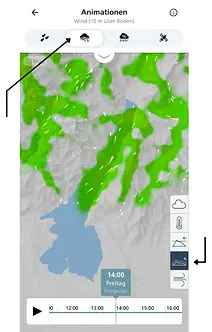
The MeteoSwiss App
The MeteoSwiss app provides a highly accurate wind forecast for the next 24 hours. Since wind conditions on Lake Garda are complex, the forecast focuses on a shorter time window to deliver the best possible accuracy.
How to check the wind forecast:
1. Open the animation in the app
2. Zoom in on Lake Garda in the bottom-right corner
3. Select the wind icon at the top (second symbol)
4. Choose “Wind at 10 m above ground”
This will show you the current wind and the forecast for the next 24 hours.
Lake Garda offers outstanding kitesurfing conditions, but with thermal winds and local effects, timing and location are everything.
Being at the right spot at the right time can make all the difference.
That’s where an experienced kite school comes in.
We monitor wind development throughout the day and decide which spot and time window offer the best conditions for your session. This way, you don’t miss the good wind and can focus entirely on your riding.
Especially for beginners, this matters:
The right conditions help you progress faster, spend more time on the water, and avoid frustrating or unproductive sessions.
Whether you're learning to kite or working on the next level, we make sure you get on the water in the best possible conditions.

Step 3
Choose the Right Kite School
Trust Local Experts
What Kite Size Should You Use on Lake Garda?
The right kite size always depends on wind strength, rider weight, and skill level.
On Lake Garda, there’s one more key factor: thermal winds that change throughout the day.
That means conditions evolve over time — and so does the ideal kite size.
Wind on Lake Garda — Pelèr & Ora Explained
As mentioned above, two main winds shape the conditions on Lake Garda:
Ora (afternoon): steady, consistent wind, typically 12–18 knots
Pelèr (morning): usually stronger and slightly gustier, typically 15–25 knots
Because these winds build and fade at different times of day, kite size selection often changes between morning and afternoon sessions.

Typical Kite Sizes on Lake Garda
Based on our experience, these are common reference ranges:
Afternoon (Ora): approx. 12–15 m²
Morning (Pelèr): approx. 9–12 m²
👉 Important: These are general guidelines only. The right kite size always depends on your weight, skill level, and the actual conditions on the day.
Why the Right Kite Size Matters
Choosing the wrong kite size can quickly lead to:
-
Unnecessarily exhausting sessions
-
Slower learning progress
-
Increased safety risks in stronger conditions
On Lake Garda, selecting the right size is especially important. Since sessions often start by boat offshore, thermal winds and local effects can be harder to judge from land.
Special Conditions & Exceptions
Strong Wind Conditions
After thunderstorms, wind strength can increase significantly — sometimes above 30 knots.
In these situations, we adjust sessions flexibly and only go on the water when conditions are safe.
Light Wind Conditions
If the wind is too light for a standard kite lesson, we may switch to a foil session to make the most of the available conditions.
The Best Kitesurfing Spots on Lake Garda
If you're planning to kite on Lake Garda, here you'll find a selection of the top kitesurfing spots known for reliable wind and easy access.
We’ve evaluated these spots based on wind reliability, accessibility, sun exposure, and the availability of kite schools.
While Lake Garda generally offers excellent wind conditions, certain areas benefit from local thermal effects that can make the wind stronger — or weaker — depending on the location.
The better you know the lake, the easier it becomes to find the areas with the best wind on any given day.

1. Malcesine — The Top Kitesurfing Spot on Lake Garda
Our top pick. Malcesine offers ideal conditions for both beginners and advanced riders. The wind here is consistent and usually lasts the longest.
Early starts and long sessions with Pelèr in the morning and Ora in the afternoon
Direct water access with shorter boat rides compared to other areas
Excellent infrastructure with kite schools, shops, and plenty of activities nearby
2. Campione del Garda — Ride Independently from Shore
Campione is one of only two spots on Lake Garda where you can launch without a boat. After registering with the local kite club, you’ll have access to a rescue service if needed.
Ideal conditions for advanced riders
Reliable morning wind with the Pelèr
Sun disappears behind the mountains from around 5:00 pm
3. Brenzone – Less tourism
Brenzone is a great choice if you prefer a quieter atmosphere than busier areas like Malcesine. From here, boat transfers typically take you across the lake toward Campione.
Reliable Pelèr wind in the morning
Well-established kite schools nearby
Ora wind less consistent than in Malcesine
4. Navene — Advanced Riding Spot
Navene is another of the few spots on Lake Garda where kiting without a motorboat is possible.
Independent riding — best suited for advanced kitesurfers
Quick access to solid wind conditions
Limited infrastructure compared to larger spots
5. Torbole — Popular Spot with Great Facilities
Torbole is one of the most popular kite destinations on Lake Garda, known for its strong infrastructure and reliable wind patterns.
Pelèr and Ora provide consistent wind opportunities
Wide range of kite schools for beginners and advanced riders
Kiting allowed further south, requiring a longer boat transfer from Torbole